

According to the Center for Disease Control’s National Center for Health Statistics, more than half of American adults suffer from some type of muscle pain. Physical therapists are experts at understanding the origin of pain and have many tools at their disposal when designing a personalized treatment plan. One of those services your physical therapist may suggest is dry needling.
What is Dry Needling?
Dry needling is a service provided by certified physical therapists that use a very thin needle that is inserted into the tender spot of a muscle to “trigger” a contract/relax response. This in turn helps to draw oxygenated blood to the painful area to release muscle tension and promote healing. When performed by physical therapists, dry needling can target trigger points to reduce pain and improve range of motion.
To provide dry needling to their patients, a physical therapist must receive additional training and certification. Dry needling is only one segment of an individualized care plan that is designed with each patient’s goals in mind.
What’s a Trigger Point?
When muscles become overburdened, they can develop knots that are called trigger points. Trigger points can be a source of longstanding pain. If not addressed, trigger points can limit muscle function. Using the very thin needle, your physical therapist will locate a trigger point and insert the dry needle.
This causes a ‘contract & relax’ reflex of the trigger point within the muscle. In turn, this draws oxygenated blood to the painful area and aids in a release of muscle tension and promotes healing.
Who Can Benefit from Dry Needling?
Dry needling can be used with many medical conditions or diagnoses. It is most frequently used for patients dealing with conditions such as:
- Back and neck pain
- Shoulder, elbow, or hip pain
- Headaches
- Sciatica
Here’s What to Expect During Dry Needling:
Before beginning dry needling, your physical therapist will thoroughly discuss the process and answer your questions so that you have a clear understanding. From there, your physical therapist will:
- Palpate (use their hands to feel) for areas of muscle tightness and identify if a trigger point is the source of your discomfort.
- Put on gloves and clean your skin with alcohol.
- Gently hold the area of the trigger point and slowly insert the needle. Many people say that the needle is so thin they do not even feel it!
When performed effectively, dry needling elicits a twitch response as the area of the muscle contracts and relaxes. Some patients describe the sensation as a short muscle cramp that quickly relaxes. Unlike acupuncture which targets the meridian line to balance the flow of energy, dry needling targets the specific point of a muscle where the pain is present. The twitch that occurs releases the longstanding contraction.
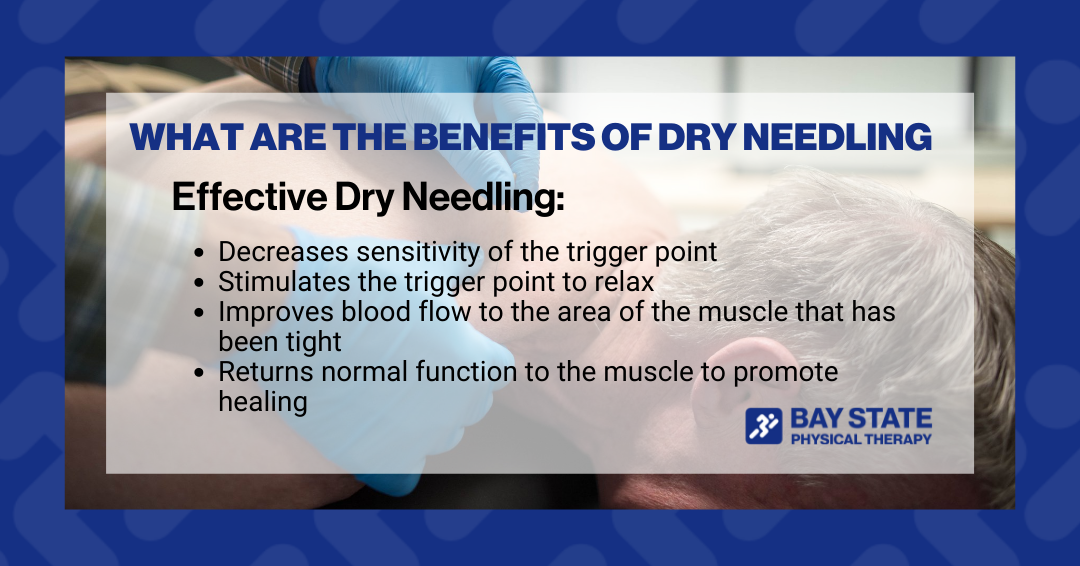
What are the Benefits of Dry Needling?
While physical therapists use manual techniques to address areas of superficial pain, there is only so deeply their touch can reach. Dry needling allows the physical therapist to isolate the exact location of muscle pain.
Learn More about Dry Needling
If you are injured or are dealing with pain, you are not alone. As your partner in health, Bay State Physical Therapy is just a call or click away. Learn more about dry needling by clicking the button below.
Don’t delay the care you need to live a full and active lifestyle. Contact your nearest Bay State Physical Therapy location or complete the form below to request an evaluation.